Shopify CEO Tobi Lütke on Why Using AI Isn't Optional: Agents, Shopping and Who Gets Paid
Shopify CEO Tobi Lütke on AI shopping agents, who pays when they buy, and why everyone will have to use AI to get ahead. Our summary and takeaways.
By Tech Team Strategy · Nov 3, 2026 · 6 min read
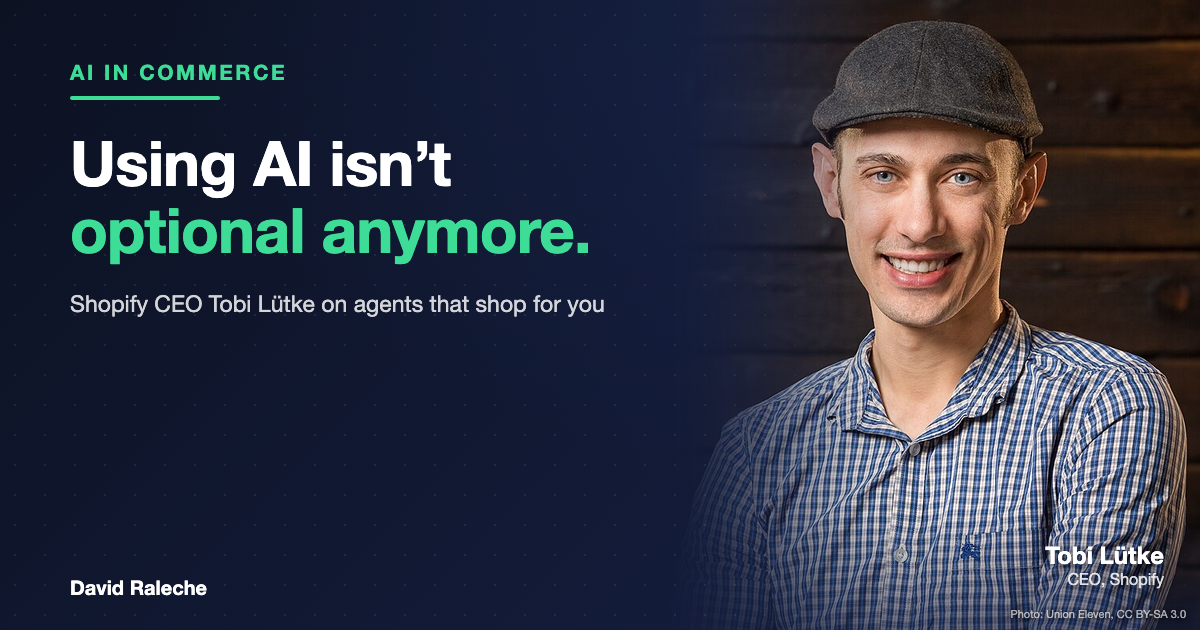
In an episode of the Sources podcast, host Alex Heath sits down with Tobi Lütke, co-founder and CEO of Shopify, in Toronto. They start with a news story, Amazon blocking Meta's Muse while Shopify welcomed it, and end up covering how agents will change shopping, who gets paid when an AI buys for you, why Lütke thinks using AI is no longer optional, and why a wine cellar is now a server rack.
This article is our own summary of the conversation, with short quotes and timestamps from the episode's transcript. Watch the full interview above for everything that was said.
The short version
- Two philosophies of commerce. Amazon is the digitized department store and "the everything store." Shopify backs independent merchants who tell their own story. Different philosophies, so different answers on agents (0:14 to 2:00).
- Shopify has no ads business to protect. It deliberately built no marketplace, so it stays "on the same side of the table" as merchants (2:00 to 3:05).
- Agents are already buying. The early pattern is project-based, higher-value orders, such as everything for a home gym or a weekend 3D-printing project (7:00 to 10:00).
- Pessimism sounds smart, optimism sounds naive. Lütke argues AI is a new frontier and that zero-sum thinking is a choice (13:04 to 20:01).
- AI use is expected at Shopify. His 2025 memo asked teams to use AI reflexively, and inside the company it was not controversial (45:06 to 52:04).
- Don't obsess over take rates. He cares about "gross profit dollar growth," not percentages (59:05).
- Be "too good to ignore." His advice to agent startups and to careers alike (1:09:05).
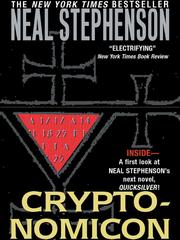
Cryptonomicon
Neal Stephenson
Tobi Lütke is reading: “Recently reread it: "literally everything in the book just happened."”

People they admire
- Mark Zuckerberg: Praises Zuckerberg as an entrepreneur and thanks Meta for open-sourcing Llama.
As an Amazon Associate, RALECHE earns from qualifying purchases.
The words worth stealing from this conversation, what they mean, and who said them.
Elegant words
- zero-sum thinking
- The belief that one person's gain must equal another's loss, meaning resources are strictly limited.
- Tobi Lütke: “Lütke argues AI is a new frontier and that zero-sum thinking is a choice.”
- survivorship bias
- The logical error of focusing on successful examples while ignoring failures, leading to false conclusions.
- Tobi Lütke: “AI now gives everyone that, avoiding the survivorship bias of the past.”
- loosely coupled
- An organizational or system design where components are weakly connected, allowing flexibility and independent action.
- Tobi Lütke: “He describes teaching everyone to run the same decision function: pick the next best step, loosely coupled.”
- convergent
- Tending to move toward the same point, style, or cultural norm over time.
- Tobi Lütke: “His critique of Silicon Valley is that companies are 'very convergent,' with similar cultures.”
AI vocabulary
- agents
- Autonomous AI systems designed to perform tasks, make decisions, and interact with software on behalf of a user.
- Tobi Lütke: “On agents that control a browser, he calls the approach 'cheeky' and says it 'doesn't work well but it makes everything possible.'”
- open-sourcing
- The practice of making software code or AI models freely available for anyone to use, modify, and distribute.
- Tobi Lütke: “He praises Mark Zuckerberg as an entrepreneur and thanks Meta for open-sourcing Llama.”
Tech vocabulary
- APIs
- Software interfaces that allow different computer programs to easily communicate and share data with one another.
- Tobi Lütke: “Shopify is building APIs so checkout works well, and whether a person or an agent buys, 'that's fine by us.'”
- take rate
- The percentage fee or commission collected by a platform or marketplace for facilitating a transaction.
- Alex Heath: “Heath asks where the take rate in agentic commerce will come from, since Shopify's roughly 3% mostly goes to card companies.”
- gross profit dollar growth
- The absolute increase in total profit dollars earned, rather than focusing on percentage margins.
- Tobi Lütke: “I don't care about gross profit. I care about gross profit dollar growth.”
- server rack
- A standardized physical frame or cabinet designed to hold and organize multiple computer servers and hardware.
- Tobi Lütke: “He turned a wine cellar into a server rack with a GB300 from Dell, which trains models locally.”
Trends and buzzwords
- agentic commerce
- E-commerce transactions initiated, negotiated, or completed by autonomous AI agents instead of humans.
- Alex Heath: “Heath asks where the take rate in agentic commerce will come from.”
- AI-first
- An approach where artificial intelligence is prioritized as the core technology driving business operations and products.
- Tobi Lütke: “A manager hired from outside may not have the tools a founder has to build an AI-first Shopify.”
What he said, by topic
Amazon, Shopify and agents (0:00 to 7:00)
Lütke says he learned only after posting that Shopify was embracing Muse, and that the contrast with Amazon is nothing new: "that's been the last 20 years." One side is the digitization of the department store, strong on inventory depth. The other is boutique-style independence and entrepreneurship. He explains that Shopify avoided building a marketplace because a marketplace is three-sided and has to choose between buyers and sellers. On agents that control a browser, he calls the approach "cheeky" and says it "doesn't work well but it makes everything possible." Shopify is building APIs so checkout works well, and whether a person or an agent buys, "that's fine by us."
How shopping is changing (7:00 to 11:00)
Agent-driven buying started from a low base, so percentages are "absurd" but not meaningful yet. What matters is the kind of purchase: project-based and fairly high order value. His example is asking an agent to buy everything for a weekend project with your kids, with the agent placing orders from online and local stores. He thinks agents are currently helping people do existing things better, and that a phase of "completely new things" follows.
Optimism, sci-fi and zero-sum thinking (11:00 to 21:00)
He recently reread Neal Stephenson's Cryptonomicon and says "literally everything in the book just happened." He links a long stretch of dystopian sci-fi to tech pessimism, and says humans need a frontier: without perceived growth the "correct strategy ends up becoming competing for what's already exists." Software we "train rather than write," he notes, sounds like science fiction too.
The AI backlash (21:00 to 35:00)
He sees entrepreneurship as one of the jobs that benefits most from AI. Once, he says, about 80% of Shopify users had someone who would answer an entrepreneurial question within 24 hours, which meant survivorship bias. AI now gives everyone that. He calls the fear around AI partly a story problem and expects personal experience with it to change minds. On regions, he finds the US the earliest adopter, Europe more cynical and Canada in between, proud of its role in AI research.
Founders, Meta and Silicon Valley (35:00 to 44:00)
He praises Mark Zuckerberg as an entrepreneur and thanks Meta for open-sourcing Llama, saying it set a norm others followed. His critique of Silicon Valley is that companies are "very convergent," with similar cultures and the same planning systems. Companies with a founder in place, he says, can cut through red tape and make decisions fast.
Building an AI-first Shopify (45:00 to 52:00)
A manager hired from outside may not have the tools a founder has to send a company-wide memo. He says "I've never had an annual plan" and describes teaching everyone to run the same decision function: pick the next best step, loosely coupled. A skeptic "is never going to be a top performer" where everyone uses agents, so he makes the expectation explicit rather than vague.
Who profits from agents? (52:00 to 1:03)
Heath asks where the take rate in agentic commerce will come from, since Shopify's roughly 3% mostly goes to card companies. Lütke is relaxed about it: agents create real value, people will pay, and it may end up charging the user, metering or a share of transactions. His own priority: "I don't care about gross profit. I care about gross profit dollar growth," achieved by making entrepreneurship easier. The number one time for starting a Shopify business is the local lunch break.
Risks, humility and being too good to ignore (1:03 to 1:10)
The risk he worries about most is that someone builds a better Shopify. At the start of every year he works out how he would build one, then spends the rest of the year making Shopify more like it. His advice: build a company, or a career, that is "too good to ignore."
Advertising and discovery (1:10 to 1:16)
He is not pessimistic about ads, but unsure how they net out with agents. If an assistant is paid to choose products, that would be "a breach of trust." He worries about head concentration, where all business flows to the biggest brands, and values the thousand true fans that open markets allow. He also sees an opportunity to invent new kinds of matchmaking markets for agents.
Rack, cellar and Claw (1:16 to 1:23)
He turned a wine cellar into a server rack with a GB300 from Dell, which trains models locally. It hosts his personal agent, "Claw," which runs entirely at home on his own archive of about 15 years of logs and writing. It writes him briefing notes, and he used his heart-rate data to find his most stressful meetings.
Chapter guide
- 00:00 Amazon blocks Muse
- 02:40 Shopify's approach to AI agents
- 07:00 How AI agents will change shopping
- 11:05 Sci-fi and tech optimism
- 17:57 Zero-sum thinking vs. abundance
- 21:20 AI backlash and the founder advantage
- 45:28 Building an AI-first Shopify
- 52:18 Who profits from agentic commerce?
- 1:03:22 How Shopify stays ahead
- 1:10:39 Advertising and discovery in the agent era
- 1:16:02 Rack, Cellar, and Claw
What it means for your business
- Make your store readable by agents. If an assistant is going to shop for your customers, your products, prices and policies need to be clear, current and easy to fetch.
- Decide your stance on agents now. Block, welcome or negotiate: the two companies in the story chose differently, and each choice has a cost.
- Watch who pays. When an agent buys on someone's behalf, fees, ads and ranking all get complicated. Know where your margin goes.
- Make AI use an explicit expectation. Lütke's approach: say it plainly, ask how an AI experiment failed, and let the culture follow.
- Be too good to ignore. Build something people choose over their daily coffee.
Video details
- Title: Shopify CEO on why using AI isn't optional
- Host: Alex Heath
- Guest: Tobi Lütke, co-founder and CEO of Shopify
- Published by: Sources Podcast on YouTube, October 28, 2026
- Length: about 1 hour 24 minutes
- Watch: youtube.com/watch?v=r9SHzCW9zxo
- Note: quotes come from the video's automatic transcript and are lightly cleaned. Check the video for exact wording.
Want to put this to work?
We help owners turn AI trends into a plan, a product and a launch. Book a free call or see our services.
Originally published by Tech Team Strategy
What did you think of this story?
+10 tokensTap to vote ↓
Get the briefing
The week's essential stories, free in your inbox.
More
Scott Kupor: Building a16z and Rebuilding the U.S. Government's Talent System
Scott Kupor on building a16z with the CAA model, why it marketed, and how OPM is fixing federal ratings, promotions, hiring, Tech Force and the retirement mine.
Nov 23, 2026 · 7 min
What I Learned From Amazon's Top 1%: Six Principles to Get Promoted Faster in Tech
Six promotion principles from a former Amazon principal engineer: evidence of impact, acting at the next level, project selection, a promotion headline and focus.
Nov 23, 2026 · 5 min
Brian Armstrong (Coinbase): Running a Company With AI Agents and Why Now Is the Golden Age of Building
Coinbase CEO Brian Armstrong on his team of AI agents, Coinbase Brain, fine-tuned open-weight models, agent-to-agent payments, security and the future of finance.
Nov 20, 2026 · 7 min
Comments
Sign in to commentJoin the conversation and earn 10 tokens.