Paul Graham on Startups, Ambition and Great Founders: Why the Next Giant Company Starts With a Founder
Paul Graham expects the next giant company to come from formidable founders with promising ideas, not one predictable industry. What it means for you.
By Tech Team Strategy · Oct 27, 2026 · 2 min read
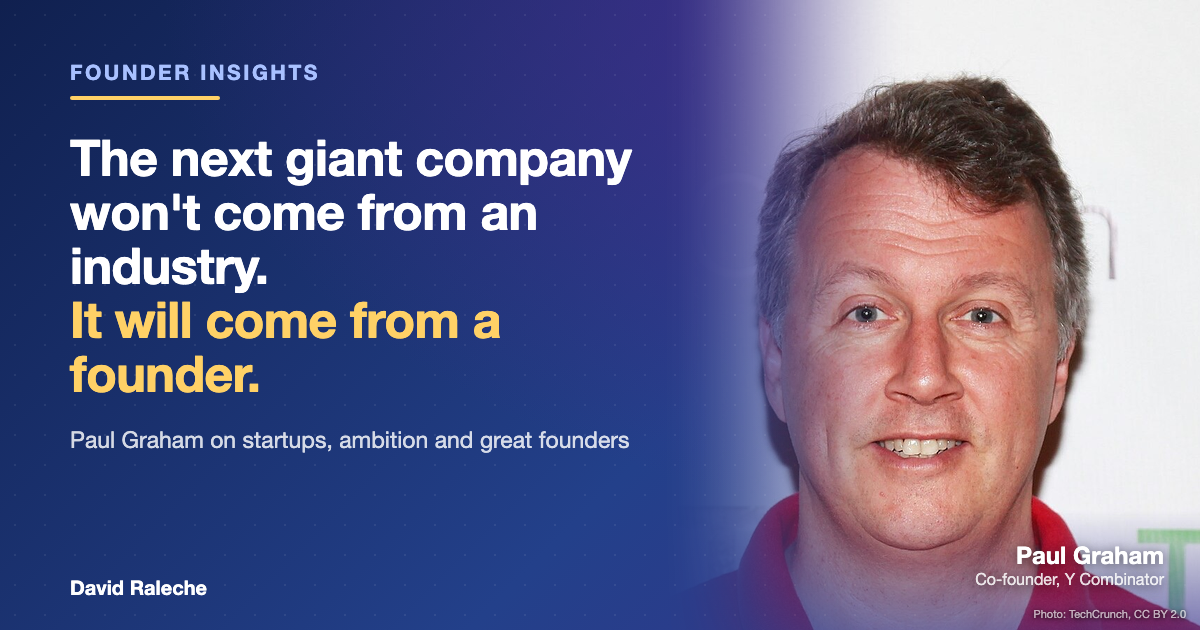
Hackers & Painters: Big Ideas from the Computer Age
Paul Graham
Paul Graham wrote: “Book by Paul Graham”

On Lisp: Advanced Techniques for Common Lisp
Paul Graham
Paul Graham wrote: “Book by Paul Graham”

ANSI Common Lisp
Paul Graham
Paul Graham wrote: “Book by Paul Graham”
As an Amazon Associate, RALECHE earns from qualifying purchases.
The words worth stealing from this conversation, what they mean, and who said them.
Elegant words
- formidable
- Inspiring fear or respect through being impressively powerful, capable, and determined.
- Paul Graham: “The description I came up with for the successful founders was formidable.”
- earnest
- Sincere, genuine, and deeply committed to a goal rather than being slick or superficial.
- Paul Graham: “Earnestness is highly correlated with success, and slickness is negatively correlated.”
- empirical
- Based on real-world observation, trial, and experience rather than theory or speculation.
- Paul Graham: “We didn't have a grand plan; Y Combinator was completely empirical.”
- inflection point
- A critical turning point where a significant and irreversible change in direction occurs.
- Vivian Shen: “It feels like we are at a massive inflection point with artificial intelligence.”
- bureaucracy
- A complex system of rules and procedures that often slows down decision-making in large organizations.
- Paul Graham: “Big companies are slow because they are choked by bureaucracy.”
AI vocabulary
- agent
- An AI program designed to autonomously perform tasks and make decisions on behalf of a user.
- Paul Graham: “We are going to see software agents doing things that used to require teams of people.”
- inference
- The process of an AI model running calculations to generate a response or prediction from new input.
- Paul Graham: “The cost of inference is dropping so fast that it changes what you can build.”
- fine-tuning
- Adapting a pre-trained AI model to a specific task by training it on a smaller, specialized dataset.
- Paul Graham: “Startups are finding that fine-tuning smaller models is often better than using giant ones.”
Tech vocabulary
- incumbent
- An established, dominant company already operating in a market that startups aim to disrupt.
- Paul Graham: “The incumbents are going to have a harder time adapting to this than they think.”
- marginal cost
- The incremental cost required to produce one additional unit of a product or service.
- Paul Graham: “AI reduces the marginal cost of writing software to basically zero.”
- custom software
- Software tailored specifically to the unique needs of a single user or business.
- Paul Graham: “In the future, almost all software will be custom software written on the fly.”
- co-founder
- A partner who helps start a company, sharing the responsibilities, risks, and decision-making.
- Paul Graham: “It is very difficult to succeed without a co-founder who can balance you out.”
- arbitrage
- Taking advantage of a temporary gap or difference in a market to gain an easy benefit.
- Paul Graham: “There is a temporary arbitrage opportunity for founders who move fast.”
Trends and buzzwords
- one-person unicorn
- A startup run by a single individual that reaches a valuation of one billion dollars.
- Vivian Shen: “Do you think we will see the first one-person unicorn company soon?”
- AI-native
- Built from the ground up to center around artificial intelligence, rather than adding it later.
- Vivian Shen: “Are the most exciting startups today the ones that are truly AI-native?”
In a conversation published by Y Combinator, YC Visiting Partner Vivian Shen sits down with Paul Graham at the original YC office in Mountain View to talk about startups, AI, ambition and what makes great founders.
The idea we took from it: Graham expects the next giant company to come from formidable founders with promising ideas, rather than from one predictable industry or concept.
This article is our own commentary on that idea. Watch the full interview above for everything that was said in it.
Want the full playbook? Our detailed Executive Brief on Paul Graham covers thirteen themes with his own quotes and timestamps, what AI did and didn't change for startups, key numbers, a 12-point checklist and a 30-60-90 day plan.
What the idea means
- Bet on the founder first. Industries and trends are easy to name and crowded fast. The person who keeps going when the plan changes is the harder thing to copy.
- Promising beats predictable. The obvious category is where everyone is already looking. Large outcomes tend to start somewhere that looks small or odd at first.
- Ambition is a working habit. It shows in how quickly someone ships, listens and tries again.
What to do with it in your own business
- Pick one real problem your customers already complain about, and solve it end to end before widening the scope.
- Use AI to move faster, not to chase the trend. Small teams can now build and test in days what used to take months.
- Hire and partner for drive. Skills can be taught; relentlessness is hard to add later.
Get the detailed Executive Brief
Our Executive Brief: Paul Graham on Startups, Ambition, Great Founders and What AI Changed goes much further than this article:
- What AI changed for startups (the new AI bills) and what it didn't, in his words
- Eight numbers worth remembering, clearly attributed
- Thirteen themes explained, each backed by short quotes with timestamps
- A table of AI lessons for founders
- A 12-point checklist, six questions and a 30-60-90 day plan
- A quote bank of 20 more lines and a timestamped chapter guide
Video details
- Title: Paul Graham On Startups, Ambition, and Great Founders
- Interviewer: Vivian Shen, YC Visiting Partner
- Interviewee: Paul Graham, YC co-founder
- Published by: Y Combinator on YouTube, September 3, 2026
- Length: about 21 minutes
- Watch: youtube.com/watch?v=5bxp78i96S8
Want to put this to work?
We help owners and founders turn ideas like this into a plan, a product and a launch. Book a free call or see our services.
Full transcript
Read the whole interview, word for word, with a timestamp on every answer. Free with a sign-in.
Sign in to read itOriginally published by Tech Team Strategy
What did you think of this story?
+10 tokensTap to vote ↓
Get the briefing
The week's essential stories, free in your inbox.
More
Scott Kupor: Building a16z and Rebuilding the U.S. Government's Talent System
Scott Kupor on building a16z with the CAA model, why it marketed, and how OPM is fixing federal ratings, promotions, hiring, Tech Force and the retirement mine.
Nov 23, 2026 · 7 min

What I Learned From Amazon's Top 1%: Six Principles to Get Promoted Faster in Tech
Six promotion principles from a former Amazon principal engineer: evidence of impact, acting at the next level, project selection, a promotion headline and focus.
Nov 23, 2026 · 5 min
Brian Armstrong (Coinbase): Running a Company With AI Agents and Why Now Is the Golden Age of Building
Coinbase CEO Brian Armstrong on his team of AI agents, Coinbase Brain, fine-tuned open-weight models, agent-to-agent payments, security and the future of finance.
Nov 20, 2026 · 7 min
Comments
Sign in to commentJoin the conversation and earn 10 tokens.