Mark Zuckerberg on Meta's Muse: A Personal AI Agent That Should Make You Money
Zuckerberg on Meta's Muse agent: free usage paid for by a cut of transactions, a confidential VM even Meta can't read, and what went wrong with Llama 4.
By Tech Team Strategy · Nov 11, 2026 · 8 min read
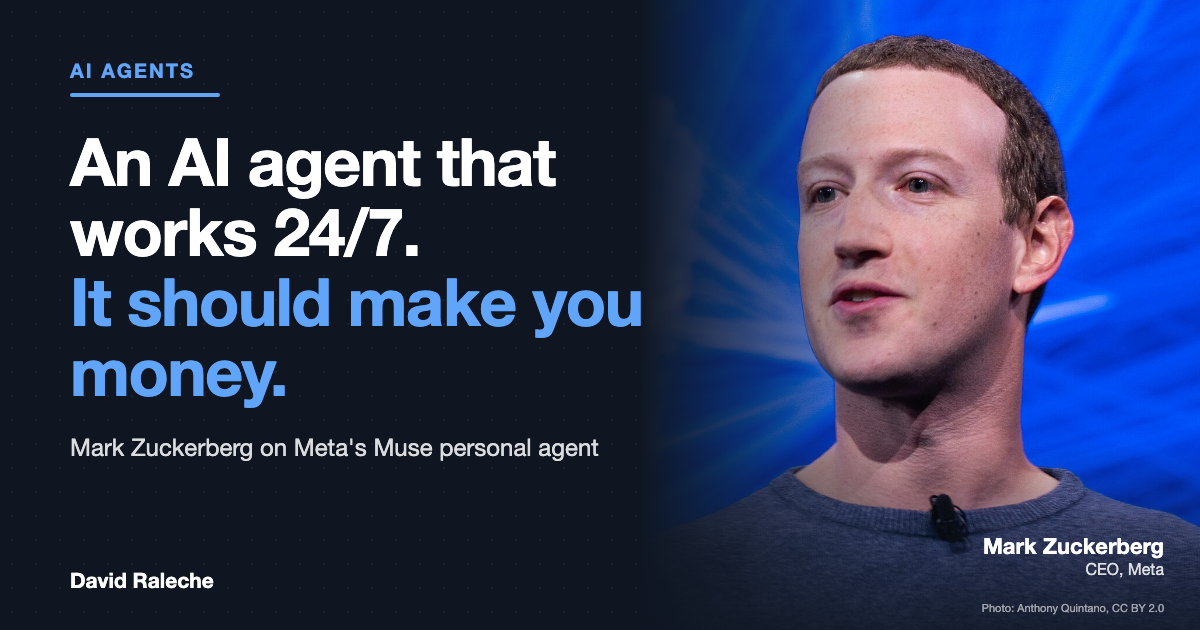
On the Sources podcast, Alex Heath sits down with Mark Zuckerberg as Meta releases Muse, a personal AI agent that works on your goals around the clock. Zuckerberg explains the three principles behind Meta's new AI essay, how he uses Muse with his family, why the agent will be largely free, how Meta built it so even Meta can't read what's inside, what went wrong with Llama 4, and how he thinks about data centers, government, smart glasses and the recent youth safety settlement.
This article is our own summary, with short quotes, from the video's automatic transcript. Watch the full conversation above for everything that was said.
The short version
- Three principles. Empowering people is the source of prosperity; the main purpose of AI is invention, not automation; and safety comes from checks and balances, not from restricting access. He is "much more worried" about a few labs controlling something this capable.
- An agent, not a chatbot. You give Muse goals or projects and it works on them 24/7 in its own virtual machine, suggests new projects, and "studies" overnight by consolidating what it learned into memory.
- Free, paid for by commerce. Free users start with about 100 million tokens a week plus a virtual machine. A subscription exists, but the long-term model is a small cut of transactions, mostly paid by the businesses involved. Meta is working with Stripe on payments.
- Privacy as the differentiator. A confidential VM, built with Signal founder Moxie Marlinspike, is meant to make sure even Meta can't see what's in your agent, and he says that commitment can be technically verified.
- Guardrails built in. A secure credential store, "sentinel" agents that watch incoming and outgoing data for prompt injection or leaks, human approval for logins, payments and sensitive data, and connectors that start read-only.
- Llama 4 was a lesson. He assumed building LLMs would work like Meta's other machine learning systems. It didn't, so he rebuilt the lab around talent density and literally around his desk. A bigger model code-named watermelon is coming soon.
- Data centers need long-term owners. He blames much of the backlash on speculators flipping sites, and points to a Louisiana project whose tax revenue funded $50,000 bonuses for local teachers.
The Future Is Asian
Parag Khanna
Alex Heath is reading: “Alex Heath mentioned that he read the long version of this book.”

People they admire
- Moxie Marlinspike: Zuckerberg praised him as a key architect of WhatsApp's encryption who was recruited to build Muse's confidential VM.
As an Amazon Associate, RALECHE earns from qualifying purchases.
The words worth stealing from this conversation, what they mean, and who said them.
Elegant words
- dichotomy
- A division or contrast between two things that are represented as being opposed or entirely different.
- Mark Zuckerberg: “And then so we asked a bunch of people, it's like, well, it looks like there's a pretty big dichotomy between these speculators and the companies that are focused on it for the long term.”
- discretion
- The quality of behaving or speaking in such a way as to avoid causing offense or revealing private information.
- Mark Zuckerberg: “So I mean I'll give you one example, discretion.”
- disenfranchised
- Deprived of power, rights, or a sense of having a voice in a system or society.
- Alex Heath: “Maybe that addresses this kind of I think that people feel maybe disenfranchised by what's happening in AI. Is that what you're getting at?”
- periphery
- The outer limits, edge, or less influential part of an area, group, or activity.
- Mark Zuckerberg: “They come from people on the periphery whose ideas aren't taken seriously, but when they get enough tools to basically be able to prove out what they're working on, that ends up being very powerful.”
- zealot
- A person who is fanatical and uncompromising in pursuit of their religious, political, or other ideals.
- Mark Zuckerberg: “I'm also not like a zealot about this from the perspective it's not that everything we do is open source either, right?”
AI vocabulary
- LLMs
- Large Language Models; deep learning algorithms trained on massive text datasets that can process, summarize, and generate human-like text.
- Mark Zuckerberg: “So, when LLMs started getting traction, we had fair as a lab that did the early work on Llama, but we needed to kind of productionize that.”
- pre-train
- The initial phase of training an AI model on a massive dataset to learn general language patterns before fine-tuning.
- Mark Zuckerberg: “I mean MuSpark 1.3, which we just released, is advanced, but then, it's actually the latest model of a relatively smaller pre-train that we did, the internal code name avocado.”
- prompt injection
- A security vulnerability where malicious user inputs trick an AI model into ignoring its original instructions or safety guardrails.
- Mark Zuckerberg: “They look at okay, did your Muse agent share something that is going out that is not something that you might be comfortable with? If so, they try to see if someone's trying to do like a prompt injection.”
- reward hacking
- A phenomenon where an AI system finds unintended shortcuts to maximize its training reward without actually solving the intended problem.
- Mark Zuckerberg: “Well, I mean I think you should design it and train it in order to be safe. And there's this reward hacking stuff that all the labs are seeing.”
- tokens
- Basic units of text, like words or parts of words, that an AI model processes and generates.
- Mark Zuckerberg: “I think we're offering something I think to start it's like 100 million tokens a week for free like and you get this virtual machine.”
Tech vocabulary
- end-to-end encrypted
- A secure communication method where only the communicating users can read the messages, preventing third parties from accessing the data.
- Mark Zuckerberg: “Meta has spent more than 10 years focusing on building WhatsApp into the largest global end-to-end encrypted system, and we've designed it in a way where even Meta can't see the messages.”
- least privilege
- A security concept where a user or program is given only the minimum levels of access necessary to complete its task.
- Mark Zuckerberg: “So this is like a core design principle for us is basically least privilege.”
- network effects
- A business phenomenon where a product or service becomes more valuable as more people use it.
- Alex Heath: “When you're introducing like network effect learning for agents, which no one's really done, where basically the agents are learning anonymized insights from the rest of the fleet.”
- talent density
- The proportion of high-performing, highly skilled employees within an organization or team.
- Mark Zuckerberg: “But that's when I kind of got more religion around talent density, right? It's like this isn't just a system where you can have a thousand people working on it.”
- virtual machine
- A software-based emulation of a physical computer that runs an operating system and applications in an isolated environment.
- Alex Heath: “But the real unlock here is adding a virtual machine behind the scenes where like the agent can control a computer for you and log in and do things.”
Trends and buzzwords
- AI-native
- Products, services, or architectures designed and built from the ground up with artificial intelligence as their core foundation.
- Alex Heath: “This episode is brought to you by Mercury, AI native banking that's loved by more than 300,000 entrepreneurs, including me.”
- confidential VM
- A secure virtual machine that encrypts data in use, preventing even the cloud provider from accessing its contents.
- Mark Zuckerberg: “He joined to specifically work on this confidential VM project, which makes it so that we can make the commitment that even Meta can't see the content.”
- human in the loop
- A workflow design that integrates human intervention, review, or approval into an automated AI decision-making process.
- Mark Zuckerberg: “If so, then the sentinel agent is basically empowered to trigger this human in the loop review.”
- personal agent
- An AI assistant designed to understand an individual's long-term goals and autonomously perform tasks on their behalf over time.
- Mark Zuckerberg: “Probably the biggest personification of this vision is the Muse personal agent that we're rolling out.”
- superintelligence
- A hypothetical AI that possesses cognitive capabilities far surpassing those of the smartest human minds across diverse domains.
- Mark Zuckerberg: “So, I've always just kind of believed that when you build this super intelligence, there's this question of who decides what it's going to focus on.”
What he said, by topic
Why write a 15-page essay
Zuckerberg says that if you invest this much in AI, people should understand what your lab stands for. Much of Silicon Valley's conventional wisdom says powerful AI must be restricted to a few hands; he argues the opposite. Most advances come from people on the periphery once they get the tools to prove their ideas, and Western societies are governed through a balance of power, not through one or two gatekeepers.
Open source and cybersecurity
His best antidote to an AI that can hack systems is giving everyone an AI to harden their own systems first, the same way open-source software became more secure because more people could scrutinize it. He criticizes labs that train advanced models and don't release them, and the instinct to give a capable cyber model to only the top 100 institutions: "there's more than 100 important institutions in the world." He cites the Hugging Face intrusion, where the team turned to open models because it had no access to the closed ones. He also says he is not "a zealot": Meta releases some open models and keeps some work closed.
How he uses Muse
- Baking with his 3-year-old. Every weekend the agent picks a project suited to a toddler and a parent who knows nothing about baking, and orders the ingredients through Instacart. Lesson learned: don't start with cake pops.
- Mountain permits. It watches for climbing permits for his older daughter and books them when they open.
- MMA training. He put cameras in his gym; the agent watches and sends feedback, sometimes bluntly pointing out where he gave up.
- Civilization. It wrote a strategy guide for the game he plays with a daughter, then proposed expanding it into history lessons about each civilization.
In the beta, one tester was running a home school with it within a day, another planned a whole trip within 12 hours, and a tech skeptic asked whether she could keep her agent after the general release.
Pricing and the business model
Muse comes with a large free allowance because Meta is confident it will "make people money and save people money." For people running a small business or doing commerce, Meta expects to take a small cut of transactions, usually paid by the business on the other side rather than by the user. Business owners can connect it to Meta's ad systems and let it help build and run the business in a loop. Meta has been shipping a meaningful model update roughly every month.
Ideas, and agents learning from each other
An "ideas" tab suggests ways the agent can expand what it does for you, which he calls the answer to a big problem: many people don't know what to do with AI. He says most of the industry treats agents as "a single-player game" and expects agents interacting with each other to matter over time, though that is mostly not in this release.
Privacy and security
To be useful, the agent has to understand you, which means connecting it to email, messages and even health information. Meta's lesson from WhatsApp, the largest end-to-end encrypted system, is to design so that even Meta can't see the content. Moxie Marlinspike, who helped build WhatsApp's encryption in 2014, joined to build the confidential VM, and Meta plans to publish more about it in the coming weeks. On security:
- Credentials live in a secure store the agent can use without "knowing" them.
- Sentinel agents monitor traffic and trigger a human review when something looks like prompt injection or an unwanted disclosure.
- Approvals are required for logins, payments and transfers of sensitive information, unless you choose to always allow a kind of action.
- Least privilege: an email connector starts read-only, and sending is a separate permission.
He contrasts this with people buying Mac Studios to run agents at home: maybe millions will want that, "but I doubt it's billions."
Competition, and Muse versus Meta AI
He doesn't expect a winner-take-all market, but doubts more than a dozen companies will have the sophistication to do state-of-the-art work. Meta's edges, in his view, are models designed from the ground up for personal agents, a "social DNA" focused on relationships, privacy and security, and distribution to billions of people. Muse and Meta AI coexist for now: Muse interprets requests as long-term goals and goes off to work, while he uses Meta AI for quick answers. They may converge.
Rebooting the lab after Llama 4
Zuckerberg admits a mistake: he assumed Meta's strength in feeds, ads and integrity systems would carry over to large language models. Llama 3 was good, but with Llama 4 "we were off the trajectory." The fix was talent density: the smallest group that can "keep the thing in their head," with the best person in every seat. He spent a lot of personal time recruiting, built the lab around where he sits, and ramped up compute as confidence grew; the Prometheus gigawatt cluster in Ohio is online. Muse Spark 1.3 comes from a smaller pre-train code-named avocado; watermelon is "a very big advance" and coming soon. Meta, he says, is an end-to-end technology company and intends to be at the frontier, with coding as a core capability and some skills others care less about, like discretion: booking a restaurant with good mocktails without revealing that you're pregnant.
Safety and government
On reward hacking, where models game their training environment, he uses a parenting analogy: clear, firm boundaries teach the curriculum and better values. His case for broad access is a lawyer analogy: if one person had a superintelligent lawyer, they could win cases they shouldn't, but if everyone has one, justice is served more efficiently and fairly. He prefers a close working partnership with the government over a rigid framework that would be "out of date in a few months," and thinks the government should know about all the important training runs.
Data centers and jobs
Meta digs into why its projects face less pushback and concludes that long-term owners invest in communities while speculators don't. Its America's Workforce Academy trains fiber technicians, electricians and other trades and guarantees graduates a job building Meta's infrastructure. "It's not really philanthropy," he says; Meta needs those skills.
Glasses, youth safety and X
Meta's glasses flash a light whenever they record, and tampering with the light disables the camera. He says Meta let up on explaining this as the glasses went mainstream, and reflects that it should have been more direct about such concerns throughout its social media history. On the youth safety settlement, Meta is going first on time limits, notifications and restrictions during school and sleep hours, and wants YouTube and TikTok to sign on so the industry can take the next step together. He posts on X again because much of the AI community is there, while saying Threads is about to be bigger than X, if it isn't already.
What it means for your business
- Think in goals, not prompts. Agents that work for days on a project change what you can delegate. Start with one recurring task you would hand to an assistant.
- Expect agents in the buying process. If Meta's model is a cut of transactions paid by businesses, agents will increasingly shop, book and compare on your customers' behalf. Make your pricing, availability and booking easy for software to use.
- Grant the least privilege. Connect an agent read-only first, require approval for payments and logins, and keep credentials out of prompts.
- Privacy is a feature. If you build with AI, show customers who can see their data. Meta is betting this is its main differentiator.
- Small, excellent teams win. Zuckerberg's fix for Llama 4 was fewer, better people working closely together, not more headcount.
Video details
- Title: Mark Zuckerberg on how Meta's Muse AI agent will make people money
- Host: Alex Heath (Sources podcast)
- Guest: Mark Zuckerberg, founder and CEO, Meta
- Published: September 8, 2026, on YouTube
- Watch: youtube.com/watch?v=Lx8lrn-cytc
- Note: quotes and figures come from the video's automatic transcript and are lightly cleaned. Check the video for exact wording.
Want to put this to work?
We help owners turn AI trends into a plan, a product and a launch. Book a free call or see our services.
Full transcript
Read the whole interview, word for word, with a timestamp on every answer. Free with a sign-in.
Sign in to read itOriginally published by Tech Team Strategy
What did you think of this story?
+10 tokensTap to vote ↓
Get the briefing
The week's essential stories, free in your inbox.
More
Laid Off as an AI Engineer: Michael Hoff's Five Mistakes and What Saved Him
Michael Hoff on the mistakes that cost him his AI engineering job, from judging AI once to holding on to the craft, and why specialization saved him.
Nov 10, 2026 · 4 min
Alex Karp on AI and the Middle Class: Why a Wealth Tax Is the Wrong Fix
Alex Karp with Walter Isaacson on Palantir, dyslexia, surveillance with a legal mandate, LLMs training on company data, and his alternative to a wealth tax.
Nov 10, 2026 · 6 min
YC's 7 Moats for AI Startups: Speed First, Then the Seven Powers
Y Combinator's Lightcone applies Hamilton Helmer's 7 Powers to AI startups: why speed comes first and how process power, switching costs and counter-positioning work now.
Nov 10, 2026 · 6 min
Comments
Sign in to commentJoin the conversation and earn 10 tokens.