Amazon CEO Andy Jassy on Reinventing Amazon for the AI Era: What Small Businesses Can Learn
Key takeaways from Amazon CEO Andy Jassy's interview on AI demand, data center limits, smaller teams, security and human judgment, and what to do about them.
By Tech Team Strategy · Oct 26, 2026 · 6 min read
In a long recent interview, Amazon CEO Andy Jassy described a future shaped by three big shifts: AI, robotics and space technologies. AI is becoming embedded in many enterprise applications and customer experiences. Amazon expects strong demand for cloud and AI infrastructure to continue, even though power, chips, memory and data center capacity may stay constrained for years. To keep up, companies will need to rethink their products and organizations: smaller, more cross-functional teams, existing experiences reinvented from scratch, and stronger security. Through all of it, people will still rely on human judgment, critical thinking and creativity.
This article is our summary of that conversation, written for owners and leaders of growing businesses. Figures and claims below are as stated by Jassy in the interview. We have not independently verified them.
The short version
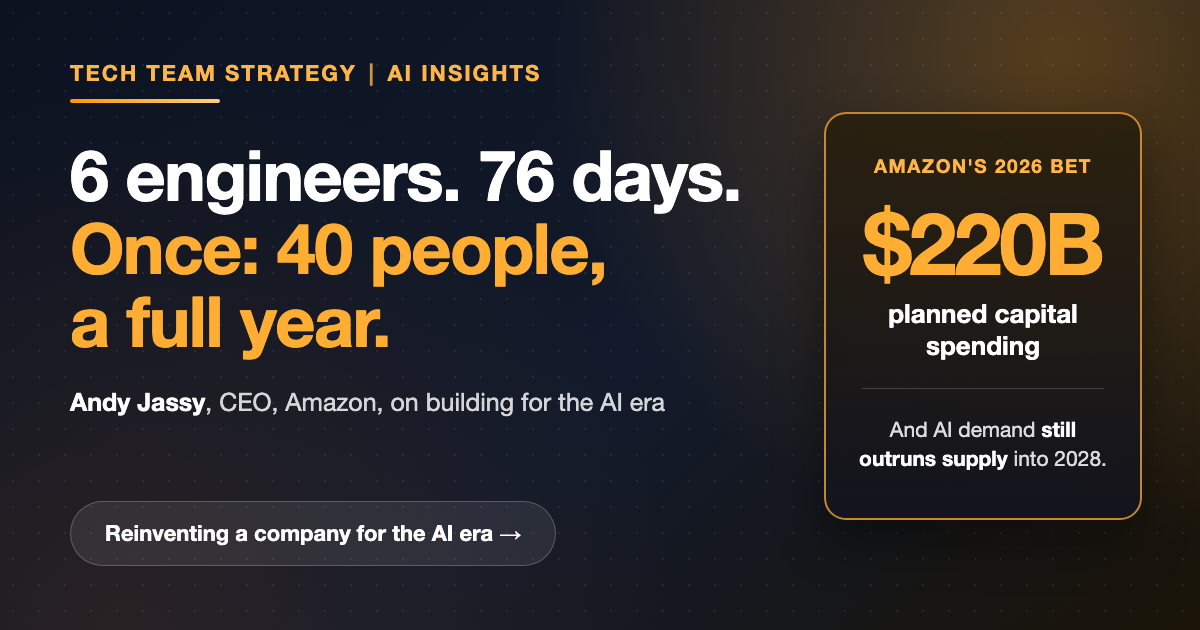
- AI demand is outrunning supply. Even at roughly $220 billion of planned spending in 2026, Jassy said Amazon is leaving meaningful demand unserved.
- Constraints will last. Power, chips and memory will remain tight, and he does not expect the shortage to end in 2027.
- Smaller, cross-functional teams win. AI lets a handful of people build what used to take dozens.
- Reinvent, do not just improve. Experiences that are merely patched with AI risk losing to ones rebuilt for it.
- Security must move at machine speed. Fixing vulnerabilities in minutes, not weeks, becomes the standard.
- People still decide. Critical thinking, judgment and experimentation stay human work.
The words worth stealing from this conversation, what they mean, and who said them.
Elegant words
- order of magnitude
- A class in a system of classification where each class is ten times greater than the one before it.
- Andy Jassy: “The cost of running AI models, even after falling sharply, is still about an order of magnitude too high for AI to be used everywhere.”
- barbell
- A distribution where power or activity is concentrated at two extreme ends rather than in the middle.
- Andy Jassy: “AI demand is a barbell.”
- connecting the dots
- Associating different ideas or pieces of information to see a larger, clearer picture.
- Andy Jassy: “Connecting the dots into a strategy, a product or a customer experience still takes human judgment, invention and experimentation.”
AI vocabulary
- inference
- The process of an AI model running live data through its trained network to calculate an output or prediction.
- Andy Jassy: “Most enterprise applications will use AI inference extensively within five to seven years.”
- generative AI
- Artificial intelligence capable of generating new content, such as text, images, or code, based on user prompts.
- Andy Jassy: “The underlying 'brain' had to be rebuilt because generative AI changed what was possible.”
- automated agents
- Software programs that can perform tasks, make decisions, and act on behalf of a user without constant human intervention.
- Andy Jassy: “Companies will have to rewrite much of their code so that automated agents can safely update it.”
Tech vocabulary
- run rate
- A financial metric that projects future performance, such as annual revenue, based on current short-term data.
- Andy Jassy: “AWS is growing about 37% year over year on a run rate of roughly $169 billion.”
- price performance
- A ratio measuring the value or efficiency of a technology relative to its cost.
- Andy Jassy: “Amazon builds its own chips, which deliver roughly 30 to 40 percent better price performance than comparable alternatives.”
- vulnerabilities
- Weaknesses or flaws in software code that can be exploited by attackers to compromise security.
- Andy Jassy: “Models find many more vulnerabilities than people did.”
- capital investment
- Funds spent by a company to acquire, upgrade, and maintain physical assets like property, buildings, or technology.
- Andy Jassy: “Amazon expects to spend about $220 billion on capital investment in 2026 and could spend more.”
Trends and buzzwords
- AI-native
- Designed and built from the ground up to utilize artificial intelligence as a core component, rather than adding it later.
- Andy Jassy: “Startups are being built 'AI native' from day one, while older companies must learn to build at that pace.”
- robotics
- The branch of technology that deals with the design, construction, operation, and application of automated physical machines.
- Andy Jassy: “AI, robotics and space development are the three biggest transformations of our time.”
1. Demand is far ahead of capacity
Jassy said Amazon expects to spend about $220 billion on capital investment in 2026 and could spend more. Capacity for 2026 is effectively sold out, 2027 is largely sold out, and a good part of 2028 is already spoken for. He described AWS growing about 37% year over year on a run rate of roughly $169 billion, and AI revenue inside AWS above $25 billion in just the first three years of this wave. For comparison, he noted early AWS was a business of about $60 million a year after its first three years.
His explanation for why that spending is not reckless: Amazon has good visibility into customer demand. Data centers must be built about two years ahead, but servers and networking equipment are bought only months ahead, once demand is clear.
2. The "barbell" of AI demand
Jassy described AI demand as a barbell. On one end are the AI labs and a few runaway applications consuming enormous amounts of computing. On the other end, enterprises use AI mainly for cost avoidance and productivity, such as automating customer service, fraud checks and business processes. The big middle, the production applications most companies run today, mostly does not use AI in a pervasive way yet. He expects that middle to become the largest segment, and predicts most enterprise applications will use AI inference extensively within five to seven years.
3. The cost of AI is the unlock
One of the most practical points: Jassy said the cost of running AI models, even after falling sharply, is still about an order of magnitude too high for AI to be used everywhere. If rewriting an application to use AI chips costs far more than staying on traditional processors, the extra benefit has to be large. Cut the cost, and the bar drops. That is why Amazon builds its own chips, which he said deliver roughly 30 to 40 percent better price performance than comparable alternatives.
What it means for you: AI is getting cheaper, but not free. Start with uses where the value is obvious today (answering calls, drafting, summarizing, triage), measure the cost, and expand as prices fall.
4. Smaller teams that work across functions
Jassy shared two striking examples. A team of six engineers rebuilt a core inference engine in 76 days, work he said would once have taken about 40 people a year. And a small group built a working prototype over a weekend that was close to shippable by Sunday. His conclusion: teams will be smaller, people will work across several functions instead of owning one narrow slice, and companies will employ fewer people doing today's tasks, while new kinds of jobs appear that nobody has defined yet.
He also warned that startups are being built "AI native" from day one, while older companies must learn to build at that pace or become more vulnerable.
5. Reinvent the experience, not just improve it
Treating AI as a small upgrade to an existing product is, in Jassy's view, a losing plan. He pointed to Alexa, whose underlying "brain" had to be rebuilt because generative AI changed what was possible. He said Amazon has teams working on fully reimagined versions of its retail, video and other businesses, and expects some to become new apps and others to be folded into existing ones over time. He acknowledged this is hard: teams are proud of what they built and have good reasons to say "we tried that before."
6. Security at machine speed
Jassy argued the most immediate AI risk is not science fiction but cybersecurity. Models find many more vulnerabilities than people did. The old cycle of finding, classifying, patching and slowly deploying will not hold up; fixes will need to be deployed in minutes. He predicted companies will have to rewrite much of their code so that automated agents can safely update it, with constraints built in.
7. Human judgment still matters
Asked what he would tell an 18-year-old, he said you cannot avoid AI, so learn it, use it a lot, and try things outside your comfort zone. But AI will not replace critical reasoning. It can bring everyone to an advanced starting point faster, yet connecting the dots into a strategy, a product or a customer experience still takes human judgment, invention and experimentation.
8. Beyond AI: robotics and space
Jassy closed by describing AI, robotics and space development as the three biggest transformations of our time, and spoke about Amazon's satellite internet effort aimed at the hundreds of millions of households without broadband, along with autonomous driving, healthcare and robotics work.
What this means for a growing business
You do not need a $220 billion budget to act on these ideas. Five practical steps:
- Pick one customer experience to reinvent, not just patch. A good place to start is the phone: an AI receptionist that answers every call, takes messages and books consultations.
- Use small, cross-functional teams. Give two or three people the tools and the authority to build a working prototype in days.
- Write an AI policy now. Set rules for data, tools, review and incidents before staff create their own. Our AI Policy Template Pack covers three company sizes.
- Treat security as a speed problem. Know how fast you can patch, rotate keys and revoke access, and shorten it.
- Train people to think with AI, not hand over their thinking. The best results pair strong prompts with good human judgment. Our Claude Prompt Pack is a practical start.
Want help deciding where to begin? Book a free 30-minute consultation and we will suggest a first step for your business.
Source and notes
This article summarizes the recorded interview "Amazon CEO Andy Jassy on Reinventing Amazon for the AI Era." Watch the full conversation on YouTube: https://www.youtube.com/watch?v=-YMMRQ1qscI. All views and figures attributed to Andy Jassy are his, as stated in the interview. Tech Team Strategy is not affiliated with Amazon.
Full transcript
Read the whole interview, word for word, with a timestamp on every answer. Free with a sign-in.
Sign in to read itOriginally published by Tech Team Strategy
What did you think of this story?
+10 tokensTap to vote ↓
Get the briefing
The week's essential stories, free in your inbox.
More
Scott Kupor: Building a16z and Rebuilding the U.S. Government's Talent System
Scott Kupor on building a16z with the CAA model, why it marketed, and how OPM is fixing federal ratings, promotions, hiring, Tech Force and the retirement mine.
Nov 23, 2026 · 7 min
What I Learned From Amazon's Top 1%: Six Principles to Get Promoted Faster in Tech
Six promotion principles from a former Amazon principal engineer: evidence of impact, acting at the next level, project selection, a promotion headline and focus.
Nov 23, 2026 · 5 min
Brian Armstrong (Coinbase): Running a Company With AI Agents and Why Now Is the Golden Age of Building
Coinbase CEO Brian Armstrong on his team of AI agents, Coinbase Brain, fine-tuned open-weight models, agent-to-agent payments, security and the future of finance.
Nov 20, 2026 · 7 min
Comments
Sign in to commentJoin the conversation and earn 10 tokens.